Este periodo de cuatro años, transcurrido desde el XXIV Congreso de la AIT en Porto Alegre en diciembre de 2009, ha mostrado que la necesidad de acción internacional coordinada por parte de la clase trabajadora contra el capitalismo, nunca fue mayor. El capitalismo, como sistema global sigue atrapado en las garras de una crisis que busca superar atacando a la clase trabajadora.
Un país tras otros, los gobiernos han estado -y aún siguen- hundiendo los salarios y las condiciones sociales y laborales llevando a la gente al paro en un intento de dar un impulso al enfermo sistema capitalista. La norma capitalista es “expandirse o morir” y la crisis también está siendo utilizada como pretexto para recortar los servicios públicos. De hecho, se trata de una expansión para abrir nuevos mercados y llevar capital a las corporaciones privadas. Los ricos serán más ricos y los pobres serán más pobres.
Showing posts with label IWA. Show all posts
Showing posts with label IWA. Show all posts
12.24.2013

Report of IWA`s XXV Congress in Valencia- December 6, 7 and 8 - 2013
The four years period since the XXIV IWA Congress in Porto Alegre in December 2009 has shown that the need for coordinated international working class action against capitalism has never been greater. Capitalism as a global system remains in the grip of crisis that it is seeking to overcome by attacking the working class.
In country after country governments have been, and are driving down wages, working and social conditions and throws people into unemployment in an attempt to boost the ailing capitalist system. The capitalist rule is “expand or die”, and the crisis is also used as a pretext for slashing public services. In fact this is an expansion for opening of markets and capital for private corporations. The rich shall be richer, and the poor shall be poorer.
In country after country governments have been, and are driving down wages, working and social conditions and throws people into unemployment in an attempt to boost the ailing capitalist system. The capitalist rule is “expand or die”, and the crisis is also used as a pretext for slashing public services. In fact this is an expansion for opening of markets and capital for private corporations. The rich shall be richer, and the poor shall be poorer.
12.13.2013
XXV Congresso da AIT

A nossa Internacional aprovou como nova secção a ASF-Austrália e atribuiu à ASR-Bulgária e à FAS-Austria o estatuto de Amigos da AIT.
A ZSP-Polónia assume o Secretariato da AIT para os próximos 3 anos, sendo que em 2016 celebra-se o próximo Congresso regular da AIT na Polónia.
XXV конгресс М.А.Т.

Приветствия в адрес конгресса направили, в частности, Аргентинская региональная рабочая федерация (FORA, секция М.А.Т.), Альянс рабочей солидарности (США), группа "Жерминаль" (друзья М.А.Т. в Чили), Анархо-синдикалистская инициатива "Росинанте" (Греция) и FIJL.
Заседания конгресса проходили в здании факультета филологии Валенсийского университета.
Здание, в котором работал XXV конгресс Международной ассоциации трудящихся
Заседания конгресса открыл уходящий генеральный секретарь М.А.Т. Рольф-Петтер Ларсен, который приветствовал собравшихся и пожелал им успешной работы.
12.12.2013
XXV Congreso de la AIT, un paso más del anarcosindicalismo internacional

En el transcurso del congreso quedó patente la consolidación de aspectos organizativos que son fundamentales para mejorar un funcionamiento interno que pueda revertir en una acción más coordinada. Gran parte de los esfuerzos del congreso se centraron en la coordinación de la acción sindical de las federaciones autónomas asociadas. Cabe destacar el interés en mantener una red de trabajo internacional coordinado por ramos de producción.
11.29.2013
25. Kongress der IAA in Valencia
147 Jahre nach Gründung der Ersten Internationalen treffen sich die verschiedenen Sektionen der IAA in Valencia unter dem Motto „One World, One Fight“.
Das Hauptziel blieb trotz unzähliger Ereignisse und Schwierigkeiten über nahezu anderthalb Jahrhunderte hinweg das Gleiche: die ökonomische Emanzipation der Arbeiterklasse. Dieses Ziel basiert auf soliden Prinzipien, die sich gegen die Ausbeutung der Arbeit und gegen die vom Kapital zum eigenen Profit gelenkten Kriege, bewährt haben – eine Assoziation von Organisationen, welche die Arbeiterinnen und Arbeiter unabhängig ihrer Herkunft verteidigt, mit der Überzeugung, dass wir alle dem gleichen Feind gegenüberstehen.
10.04.2013
Actions Around the World against Santander Bank
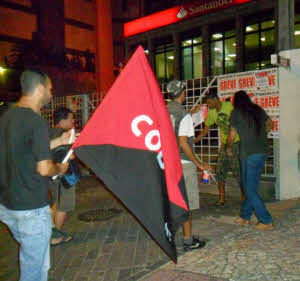 Anarcosyndicalists
from all over the world, federated in the IWA, are in solidarity with
the workers of Isban (Santander Group), demanding the reinstatement of a
dismissed comrade and an end to the outsourcing of the workers.
Anarcosyndicalists
from all over the world, federated in the IWA, are in solidarity with
the workers of Isban (Santander Group), demanding the reinstatement of a
dismissed comrade and an end to the outsourcing of the workers. COB in Brazil organized informational actions and protests in cities like Aracajú and Araxá at the end of September.
5.12.2013
Der 8-Stunden Tag, die Anarchisten und die IWPA: Haymarket und die Radikalisierung der arbeitsrechtlichen Forderungen in den 1880er Jahren
Seit langen schon ist der 1. Mai ein Urlaubstag an dem Sozialdemokraten und die etablierten Gewerkschaften sich in der Öffentlichkeit zeigen und an den Kampf für den 8-Stunden Tag erinnern. Vielleicht ist es zu dieser Gelegenheit einmal interessant zurück zu schauen und einige der Unterschiede zur damaligen US amerikanischen Arbeiterbewegung zu betrachten. Das mag uns zu verstehen helfen, dass die Haymarket-Anarchisten andere Gedanken im Sinn hatten als die sozialdemokratischen Arbeiterführer heute.
Die Forderung nach dem 8-Stunden Tag existiert seit Anfang des 19. Jahrhunderts. In den Vereinigten Staaten von Amerika wurde die Forderung nach einem 8-Stunden Tag nach einem Generalstreik in Philadelphia im Jahr 1835 erhoben. Dort wurden 10 Stunden minus zwei Stunden für Mahlzeiten eingefordert. Verschiedene Sektoren gelang es den 8-Stunden Tag durch Streiks und Agitation durchzusetzen. In einigen Staaten wurden der 8-Stunden Tag gesetzlich anerkannt. Interessanterweise fand die Hauptschlacht um den 8-Stunden Tag in Chicago statt. Der Staat Illinois hatte im Jahr 1867 den 8-Stunden Tag gesetzlich verabschiedet, doch das Gesetz hatte viele Schlupflöcher und war ineffektiv.
Die Forderung nach dem 8-Stunden Tag existiert seit Anfang des 19. Jahrhunderts. In den Vereinigten Staaten von Amerika wurde die Forderung nach einem 8-Stunden Tag nach einem Generalstreik in Philadelphia im Jahr 1835 erhoben. Dort wurden 10 Stunden minus zwei Stunden für Mahlzeiten eingefordert. Verschiedene Sektoren gelang es den 8-Stunden Tag durch Streiks und Agitation durchzusetzen. In einigen Staaten wurden der 8-Stunden Tag gesetzlich anerkannt. Interessanterweise fand die Hauptschlacht um den 8-Stunden Tag in Chicago statt. Der Staat Illinois hatte im Jahr 1867 den 8-Stunden Tag gesetzlich verabschiedet, doch das Gesetz hatte viele Schlupflöcher und war ineffektiv.
5.09.2013
IAA-Sektionen begehen den Ersten Mai und Aktionstage
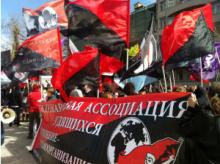
Dieses Jahr fielen die Aktionstage der Internationalen Arbeiter/innen-Assoziation (IAA) zusammen mit dem Ersten Mai. Am 01.05. und den unmittelbar vorhergehenden Aktionstagen wurden von Mitgliedsorganisationen rund um den Globus verschiedene Veranstaltungen durchgeführt.
Argentinien
Mitglieder der FORA organisierten Mai-Demonstrationen in einigen Städten, wie Buenos Aires, Neuquen und Rosario, sowie in der Andenregion. Die FORA-Mitglieder riefen die Arbeiter/innen dazu auf, freie Gewerkschaften zu gründen, welche sich nicht an Kompromissen eteiligen. Außerdem erinnerten sie an die historische Tradition ihrer Organisation.
Brasilien
Aktivist/innen der COB-FORGS machten eine Aktion am Ersten Mai in Porto Alegre. Sie demonstrierten, verteilten Flugblätter und hielten eine Kundgebung ab mit Redner/innen und Musik. Die COB demonstrierte auch in Araxa, wo sie zur Verkürzung der Wochenarbeitszeit auf 30 Stunden ohne Lohnkürzung aufrief. Auch sie sprachen sich für die Organisierung von Arbeiter/innen außerhalb der korporatistischen Gewerkschaften aus. Nach der Kundgebung zogen sie dann als Demo durch die Stadt und im Anschluß gab es ein Konzert.
4.13.2013
IAA-Aktionstage am 29/30 April und 1 Mai
Die Internationale Arbeiter/innen-Assoziation (IAA) bereitet Aktionstage vom 29. April bis 1. Mai vor. Die Aktionen sind international und richten sich gegen die kapitalistischen Sparmaßnahmen, sowie gegen Ausbeutung und Unterdrückung. Dabei liegt der Schwerpunkt auf globalen, regionalen und lokalen Themen bzw. Arbeitskämpfen usw.
1.30.2013
Kropotkin und der Wiederaufbau der Internationalen ArbeiterInnen Assoziation
-->


Im Dezember 2012 gab es für
die internationale anarcho-syndikalistische Bewegung zwei
nennenswerte Jubiläen: das 90. jährige Bestehen der Internationalen
ArbeiterInnen Assoziation und der 170. Geburtstag des bekannten
anarcho-kommunistischen Theoretikers Peter Kropotkin. Diese
Gleichzeitigkeit hat durchaus einen symbolischen Charakter. Kropotkin
war zwar nie Mitglied einer revolutionär-syndikalistischen oder
anarcho-syndikalistischen Organisation, doch er steuerte einen
wichtigen Beitrag zur Gründung der anarcho-syndikalistischen
Internationalen bei und seine Vorstellungen hatten einen enormen
Einfluss auf deren Ziele und Prinzipien.
1.09.2013
Meldungen aus der IAA
ASI (Serbien): 10 Jahre ASI.
Vor zehn Jahren, am 19. Oktober 2002, haben serbische GenossInnen die Anarcho-Syndikalistische Initiative in Belgrad gegründet. Seitdem beteiligt sich die ASI an der Organisation von Streiks, publiziert das wöchentliche Bulletin Direktna akcija und fördert das Zentrum für libertäre Studien, das dieses Jahr an der Belgrader Buchmesse teilnehmen wird. Ein wichtiger Schritt für die ASI ist die offizielle Anerkennung als Gewerkschaft, die jedoch aufgrund bürokratischer Schwierigkeiten immer noch auf sich warten lässt.1.08.2013
Solidaridad con la lucha de las trabajadoras y los trabajadores del Hospital de San Raffaele (Milán)
Estimados compañeros,como sabéis el gobierno italiano en observancia a
los poderes financieros está destruyendo el estado social, entre los
objetivos hay el sistema sanitario. Los compañeros empleados al hospital
San Raffaele, juntamente a otros sindicados, estan en huelga porque no
sean despedidos 244 trabajadores de la estructura y contra la
cancelación de los acuerdos contractuales conquistadas después muchos
años de lucha, y entre otras cosas, la compañera Graziella (delegada
USI) y Daniela se han acampadas sobre el techo del hospital para dar
mayor visibilidad a la protesta.
A sostén de tal batalla común los trabajadores y las trabajadoras del San Raffaele están empeñandos cotidianamente en huelgas y manifestaciones. Muy significativos y importantes fueron los cortejos en Milán del 24 de octubre y el 14 de noviembre, bloques viales, movilizaciones delante de la Región y al Edificio Municipal, presidios delante de las sedes de importantes órganos de información y sobre todo el Presidio Permanente a la entrada del hospital, dónde reciben muchos atestados de solidaridad de parte de la población que utiliza el servicio sanitario.En el mismo día en que las dos trabajadoras se han establecido sobre el techo más de cincuenta dependientes han ocupado los despachos de la Dirección. Fue necesario el recurso a la "fuerza pública" para hacerlos salir de peso.
A sostén de tal batalla común los trabajadores y las trabajadoras del San Raffaele están empeñandos cotidianamente en huelgas y manifestaciones. Muy significativos y importantes fueron los cortejos en Milán del 24 de octubre y el 14 de noviembre, bloques viales, movilizaciones delante de la Región y al Edificio Municipal, presidios delante de las sedes de importantes órganos de información y sobre todo el Presidio Permanente a la entrada del hospital, dónde reciben muchos atestados de solidaridad de parte de la población que utiliza el servicio sanitario.En el mismo día en que las dos trabajadoras se han establecido sobre el techo más de cincuenta dependientes han ocupado los despachos de la Dirección. Fue necesario el recurso a la "fuerza pública" para hacerlos salir de peso.
Solidarity with the struggle of the workers at San Raffaele Hospital (Milan)
Dear comrades, as you already know the Italian government, with the
behalf of the financial powers, is going on with the destruction of the
welfare state, one of the objective of this campaign is the health
assistance. Our comrades that work in the San Raffaele Hospital,
together with other unions, are striking to protest against the firing
of 244 workers and the cancellation of the contract's accord previously
obtained, and among other things, Graziella (USI's delegate) and Daniela
have went on the roof of the hospital to give more visibility to the
protest.
1922/1923: Учредительный конгресс М.А.Т. и полицейские репрессии

Учредительный конгресс синдикалистского
Интернационала, Международной ассоциации трудящихся (М.А.Т.) собрался на
рубеже 1922 / 1923 гг. на фоне крупных потрясений. Всего несколько лет
назад закончилась Первая мировая война, а за ней немедленно последовали
революционные движения во многих странах, и они наложили мощный
отпечаток на развитие всего мира.
В период войны социал-демократический Интернационал развалился,
а входившие в него партии выбросили интернационализм за борт. Их
лидеры, в частности, бывший председатель Интернационала бельгиец Эмиль
Вандервельде, активно поддерживали войну во имя их соответствующих
стран. В то же время распался и Интернационал реформистских профсоюзов. 12.19.2012
IWA-AIT 90th anniversary conference - January 2013

90th anniversary conference
5-6 January 2013, London
Revolutionary workers from across the world will gather in London for two days at the start of January 2013 to mark the 90th anniversary of the founding of the International Workers Association - based on the principles of revolutionary unionism, which signified the emergence of anarcho-syndicalism into the global labour movement.
Revolutionary unions in the IWA act as organisational forces in the daily lives of the working class, organising workplace and community resistance, and constantly linking this to the need to overthrow the double yoke of capital and the state. We aim not to reform the state: instead we are seeking the overthrow of capitalism and for it to be replaced by a self-managed libertarian communist society.
The first of the two days will look at the beginnings of the IWA at the start of the 20th century and focus on the history of sections from across the world, closing with a discussion on the re-emergence of the international following the wave of repression and war in the middle of the century. Members of various sections will give presentations and hold panels on the final day before an open discussion on anarcho-syndicalism today and perspectives and challenge from everyday practice.
12.06.2012
Conferência “AIT e Anarco-sindicalismo: alternativa atual e raízes históricas”
Realiza-se no dia 6 de dezembro, às 14h30, no Anfiteatro 7.22 - Faculdade de Ciências Sociais e Humanas.
Fonte: Grupo de Estudos Políticos e Faculdade de Ciências Sociais e Humanas
ait-sp.blogspot.de
José Rocha Paiva, da Associação
Internacional de Trabalhadores - Secção Portuguesa (AIT-SP), profere,
dia 6 de dezembro, às 14H30, no anfiteatro 7.22 da Faculdade de Ciências
Sociais e Humanas da UBI, a conferência “AIT e Anarco-sindicalismo:
alternativa atual e raízes históricas”.
A génese ideológica do anarco-sindicalismo, a história do mesmo em Portugal e seu impacto, o percurso histórico da AIT e as perspetivas futuras são os temas a tratar na iniciativa organizada pelo Grupo de Estudos Políticos da UBI.
Entrada livre.
Ver Cartaz.
A génese ideológica do anarco-sindicalismo, a história do mesmo em Portugal e seu impacto, o percurso histórico da AIT e as perspetivas futuras são os temas a tratar na iniciativa organizada pelo Grupo de Estudos Políticos da UBI.
Entrada livre.
Ver Cartaz.
ait-sp.blogspot.de
12.05.2012
Informe sobre a Plenária da AIT em Modena 23-25 de Novembro e o Centenário da USI-AIT
Delegados do Brasil, França, Grã-Bretanha, Itália, Noruega, Polónia,
Portugal, Sérvia, Eslováquia, e de Espanha como observadores, estiveram
presentes em Modena e a Plenária foi excelentemente organizada pela
USI-AIT. Sábado à noite celebrou-se o Centenário da USI-AIT com uma
manifestação, discursos e vários eventos à noite, uma vez que Modena é o
sítio em que foi fundada a USI há cem anos. Tanto a Plenária como o
Centenário realizaram-se num espírito de grande companheirismo!
No período decorrido desde a última Plenária da AIT em Varsóvia, no final de Outubro de 2011 até à Plenária de Modena, não houve apenas medidas de austeridade e cortes, mas também uma campanha ideológica contra os trabalhadores. Esta campanha tenta convencer os trabalhadores que a austeridade e a crise é “culpa deles” e não da especulação incansável e da desregulamentação da economia global. A “solução” dos estados e dos capitalistas passa por obrigar os trabalhadores a aceitarem o que eles chamam de “lógica de mercado” e as medidas de austeridade e os ataques são apresentados como necessidades “financeiras” e “leis”.
No período decorrido desde a última Plenária da AIT em Varsóvia, no final de Outubro de 2011 até à Plenária de Modena, não houve apenas medidas de austeridade e cortes, mas também uma campanha ideológica contra os trabalhadores. Esta campanha tenta convencer os trabalhadores que a austeridade e a crise é “culpa deles” e não da especulação incansável e da desregulamentação da economia global. A “solução” dos estados e dos capitalistas passa por obrigar os trabalhadores a aceitarem o que eles chamam de “lógica de mercado” e as medidas de austeridade e os ataques são apresentados como necessidades “financeiras” e “leis”.
Официальный отчет о пленуме М.А.Т.

Период с момента последнего пленума М.А.Т. в Варшаве в конце октября 2011 года и до пленума в Модене был отмечен не только мерами жесткой экономии и социальными урезаниями, но и идеологической кампанией против трудящихся. Эта кампания пытается убедить трудящихся, что жесткая экономия и кризис являются "их виной", а не результатом безрассудных спекуляций и дерегулирования мировой экономики. "Решение кризиса" со стороны государств и капиталистов - это заставить работников принять то, что они называют "логикой рынка" и мерами жесткой экономии, представив наступление на их права как "финансовую" необходимость и действие "законов".
12.03.2012
Informe de la Plenaria de la AIT en Módena, 23 -25 de noviembre y el Centenario de la USI-AIT
Asistieron a Módena compañeros y compañeras de Brasil, Francia, Gran
Bretaña, Italia, Noruega, Polonia, Portugal, Serbia, Eslovaquia y
España y la Plenaria estuvo excelentemente organizada por la USI-AIT.
El sábado por la tarde se celebró el Centenario de la USI-AIT con una
manifestación, discursos y con eventos por la noche ya que Módena es el
lugar en que se fundó la USI hace cien años. ¡Tanto la Plenaria como el
Centenario tuvieron lugar en un gran espíritu de compañerismo!.
En el periodo transcurrido desde la última Plenaria de la AIT en Varsovia a finales de octubre de 2011 hasta la Plenaria de Módena, no solamente ha habido medidas de austeridad y recortes, sino también una campaña ideológica contra los trabajadores. Esta campaña intenta convencer a la gente trabajadora de que la austeridad y la crisis ocurren por “su culpa” y no por la incansable especulación y desregulación de la economía mundial. La “solución” de los estados y los capitalistas es dictar a los trabajadores que acepten lo que ellos llaman “la lógica del mercado” y las medidas de austeridad y los ataques se presentan como necesidades “financieras” y “leyes”.
En el periodo transcurrido desde la última Plenaria de la AIT en Varsovia a finales de octubre de 2011 hasta la Plenaria de Módena, no solamente ha habido medidas de austeridad y recortes, sino también una campaña ideológica contra los trabajadores. Esta campaña intenta convencer a la gente trabajadora de que la austeridad y la crisis ocurren por “su culpa” y no por la incansable especulación y desregulación de la economía mundial. La “solución” de los estados y los capitalistas es dictar a los trabajadores que acepten lo que ellos llaman “la lógica del mercado” y las medidas de austeridad y los ataques se presentan como necesidades “financieras” y “leyes”.
Subscribe to:
Posts (Atom)